
Inside the Human Safari
Unearthing the Darkest Claims of the Bosnian War

Author’s Note: This story unsettled me in a way few others ever have. The idea that anyone—regardless of wealth, nationality, or position—would deliberately hunt unarmed civilians is almost beyond comprehension. Yet history shows us that such depravity is not an aberration; it is a recurring failure of humanity when cruelty is permitted to masquerade as power.

Writing this piece forced me to confront the darkest corners of human behavior and to recognize, once again, how fragile moral boundaries become in times of war. These events are not just distant echoes from a troubled past—they are warnings. If we do not study them, speak honestly about them, and hold accountable those who enabled them, then silence becomes complicity.
We must learn from these tragedies with unflinching clarity. We owe it to the victims, and to every generation that follows, to ensure that such horrors are neither forgotten nor repeated. Humans must do better—far better—than what history too often records.
Citizens Rule Book: A Palladium of Liberty (Download) #InfoWars 🇺🇸
In the shattered theater of the 1992–1996 Siege of Sarajevo, death did not lurk at the margins; it stitched itself into the fabric of daily life. Residents learned to calculate survival the way others calculate routine: the angles of incoming fire, the seconds between mortar blasts, the narrow window in which a body could dash across an exposed boulevard before a sniper corrected his aim. Sarajevo’s civilians moved through a city mapped not by streets and buildings, but by the invisible geometry of gunfire—a lattice of crosshairs draped over everyday existence.
Yet buried inside this already unthinkable landscape, a still more grotesque allegation has resurfaced: that wealthy foreigners paid tens of thousands of pounds for the privilege of entering this kill zone. Spirited from Trieste to Belgrade and then helicoptered into sniper positions carved into the ridgelines above the besieged capital, they allegedly took aim at unarmed men, women, and children fleeing for their lives along the city’s infamous Sniper Alley.
Official Documentary Trailer: Sarajevo Safari (Film) / By: Miran Zupanič Slovenia 2022. 🎬
If proven, it would stand as one of the most depraved footnotes of the Bosnian War: the transformation of a city’s suffering into a luxury itinerary—murder packaged, priced, and sold like a safari.
A Trade in Death
The first substantive clues emerged not during the war but years later, as Italian prosecutor Alessandro Gobbis began reopening intelligence files and eyewitness statements as part of an ongoing Milan investigation. What he found sketched the outline of a grotesque market.
According to accounts he examined, foreign participants allegedly paid between £70,000 and £88,000 per trip. The itinerary was discreet and chillingly efficient: a departure from Trieste, a quiet handoff in Belgrade, and a helicopter ascent into fortified sniper nests overlooking the starving city below. Serbian State Security operatives, reportedly including personnel linked to intelligence chief Jovica Stanišić—later convicted of war crimes—served as handlers and guides.
A Slovenian intelligence officer who monitored the movement of these visitors described them not as hardened soldiers but as tourists of carnage—affluent men in tactical jackets, adjusting scopes with the casual air of game hunters. They rotated firing positions “like enthusiasts comparing vantage points,” he recalled. Some allegedly paid premiums for the “trophy” of killing a child.
And when the excursion concluded, they were flown back to Europe’s quiet airports and discreet lounges, disappearing into the polite anonymity of civilian life.
Testimony That Refused to Fade
For years, the allegations lived in a purgatory between rumor and suppressed memory—until testimony at The Hague began giving them sharper form.
In 2007, former U.S. Marine John Jordan, who had served as an observer in the region, testified that he had personally seen foreign “shooter tourists” in the Grbavica district—men in civilian clothes but carrying hunting rifles, guided by local handlers. He described the methodical targeting of the defenseless: “If a family was walking, it would be the youngest,” he said. His testimony matched patterns documented by UN observers throughout the siege, where children were distressingly common targets.
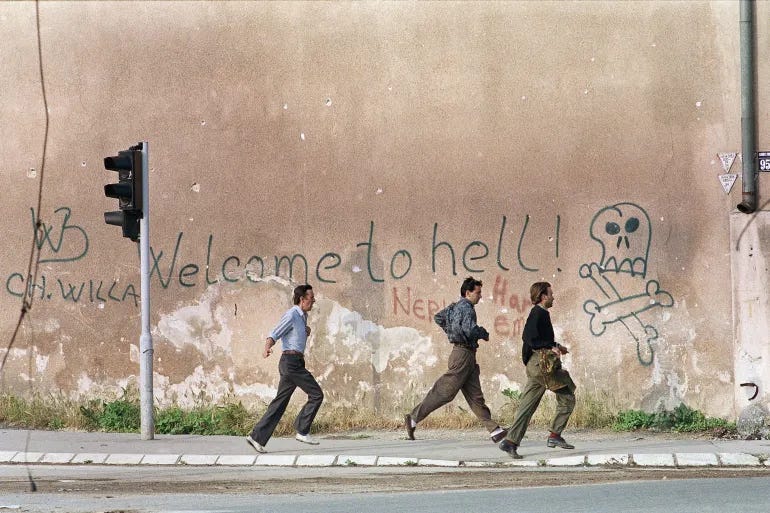
Photo: Peter Northall - Three men run for cover in Sarajevo’s notorious ‘sniper alley’ (06/09/1993)
Bosnian intelligence officer Edin Subašić added further depth. After capturing a Serbian soldier in 1993, he uncovered the structure behind the operation: weekend rotations, spotters calling out civilian movement like wildlife sightings, handlers briefing guests as if preparing them for a high-end excursion.
Italian military intelligence, SISMI, quietly investigated the reports in 1994 after Subašić’s tip. Press accounts from the era suggest SISMI confirmed the trips’ existence and worked behind the scenes to halt them. But no prosecutions followed, and the matter dissolved into diplomatic fog.
Now, journalist Ezio Gavazzeni has reignited the case. His newly published 17-page dossier, citing testimony and intelligence fragments, names five Italian suspects and calls for criminal charges, describing the allegations as “a peak of human depravity.”
A First American Probe
In the United States, the story has finally reached congressional ears. Congresswoman Anna Paulina Luna has launched an inquiry to determine whether American citizens took part in these excursions. Her office has requested coordination with European authorities and pledged that any implicated individuals will face the full force of U.S. law.
For a scandal shaped by three decades of silence, this is the first indication that American involvement—even as allegation—will receive formal scrutiny.
Whether these efforts yield indictments or collapse under jurisdictional barriers remains uncertain. But the pattern is unmistakable: those with wealth, access, and anonymity slipping into conflict zones to exploit the powerless, confident that time and distance would erase their footprints.
A Dark Lineage of Predatory Privilege
Sarajevo’s alleged sniper safaris are horrifying, but they are not aberrations in the long arc of human cruelty. History is marked by episodes where the powerful turned violence into a private sport:
In Sparta’s Krypteia, elite youths were encouraged to stalk and kill helot slaves under the cover of night.
During the Selk’nam genocide in 19th-century Tierra del Fuego, colonists and ranchers organized mounted hunts of Indigenous people, treating human lives as obstacles to commercial expansion.
In the Spanish Civil War, landowners’ sons allegedly rode down peasants like game, mocking agrarian inequality through murder.
Serial killer Robert Hansen’s 1970s Crimes in Alaska—abducting women, releasing them into the wilderness, and hunting them—were a lone wolf’s expression of the same pathology: the reduction of another human being to quarry.
Throughout the 20th century, persistent—though unverified—rumors circulated of aristocratic estates in Europe hosting clandestine “hunts,” where poachers or trespassers allegedly became human targets. Though no bodies or prosecutions ever surfaced, the stories share a common architecture: remote land, absolute privacy, utter impunity.
Sarajevo’s story fits—horrifyingly—within that lineage.
Sarajevo’s Demands for Truth
Nearly thirty years after the guns fell silent, Sarajevo still bears the scars. The famed “Sarajevo Roses”—mortar craters filled with red resin—mark the spots where civilians were killed. Apartment blocks remain pocked with sniper holes. Survivors describe instinctively flinching when crossing open spaces, a reflex born from years of mortal calculation.
For them, the idea that foreigners may have paid to worsen their suffering is not a sensational rumor; it is a wound reopened.
What they seek is not vengeance but acknowledgment. A full accounting. Answers. The restoration of moral order in a war where so much of it was shattered.
The Burden of Silence
If the allegations are ultimately proven, the sniper safaris would represent not merely isolated war crimes but a systemic commodification of human suffering—an atrocity made possible by borders, wealth, and the belief that certain lives do not matter.
If disproven, the imperative remains the same: only a rigorous investigation can honor the dead and restore clarity to a city long forced to navigate a landscape of trauma and rumor.
Bowne Report: The Minds Behind Human Safaris Run The World / By: Jon Bowne (11/17/2025)
Either way, the world owes Sarajevo more than another shrug of indifference.
For beneath the reconstructed facades and newly bustling streets, one question still drifts over the Miljacka River, unquiet and unresolved:
How many decades must pass before the darkest truths of war are no longer left to die in silence?
Sarajevo waits for that answer.
And the victims of Sniper Alley deserve nothing less.
Citizens Rule Book: A Palladium of Liberty (Hardcopies) Support my work. 🇺🇸